
Low Endotoxin Gelatin Market Forecast to Reach US$ 1.7 Billion by 2034 — Advancements in Pharmaceutical, Biotechnology, and Regenerative Medicine
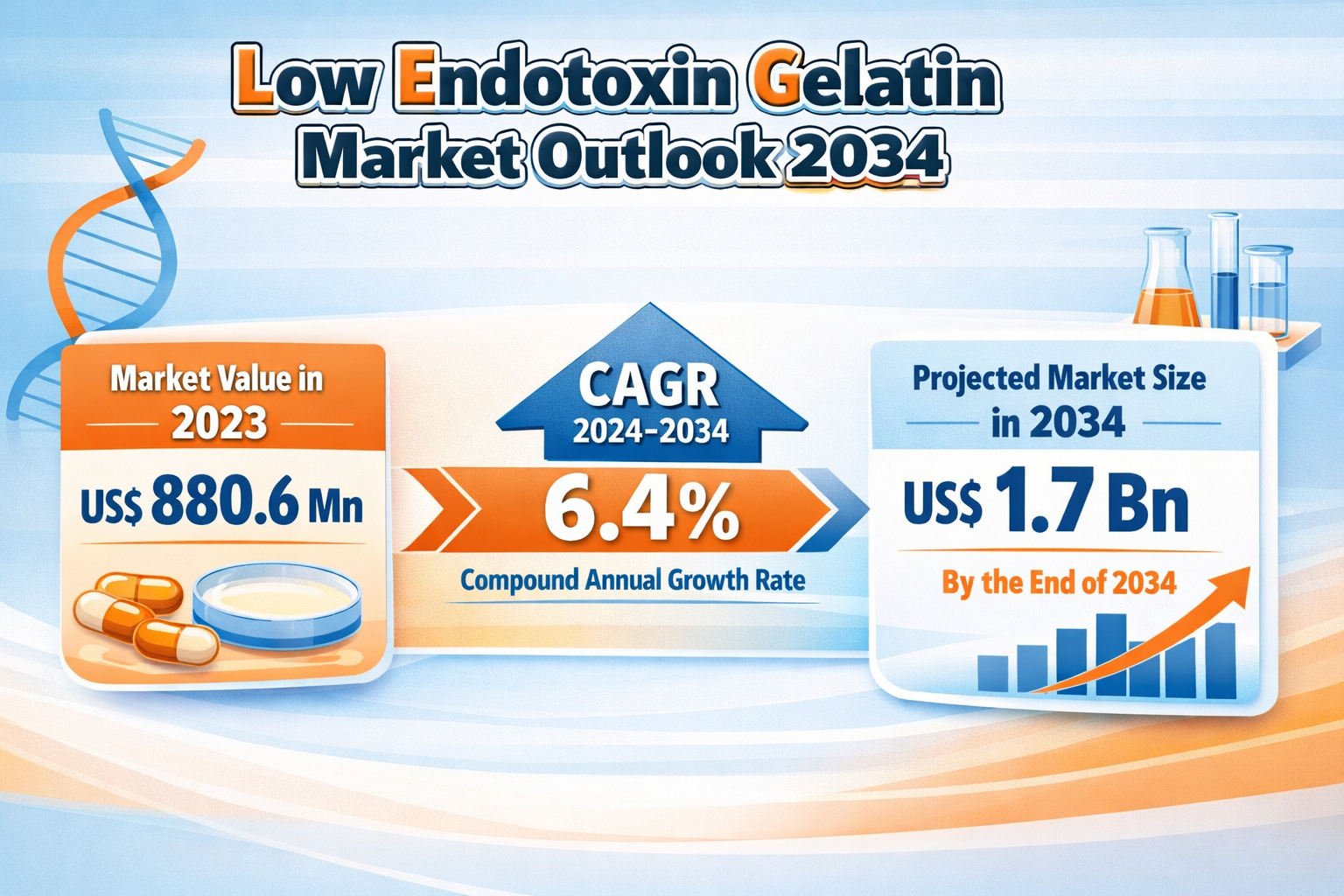
The Low Endotoxin Gelatin Market is experiencing dynamic growth, driven by its increasing applications in pharmaceuticals, biotechnology, regenerative medicine, and 3D bioprinting. Valued at US$ 880.6 million in 2023, the market is expected to reach US$ 1.7 billion by 2034, reflecting a CAGR of 6.4% between 2024 and 2034. The rising need for biocompatible materials, faster wound healing solutions, and tissue engineering applications is propelling demand for low endotoxin gelatin globally.
Overview of Low Endotoxin Gelatin
Low endotoxin gelatin is derived primarily from alkaline-treated porcine skin and is processed to minimize pyrogen content. Endotoxins, or lipopolysaccharides from gram-negative bacteria, can elicit serious immune responses such as fever, hypotension, and shock. Minimizing endotoxins is therefore critical, particularly for in-body biomedical and pharmaceutical applications.
Low endotoxin gelatin is GRAS-certified by the U.S. FDA and complies with European and Japanese Pharmacopeia standards, making it a preferred material in biomedical, pharmaceutical, and biotechnological applications. Its properties, including biodegradability, biocompatibility, non-antigenicity, and fast absorption, make it ideal for advanced wound care, tissue engineering, and drug delivery.
Market Drivers
Increasing Adoption of 3D Bioprinting
3D bioprinting has emerged as a key driver for low endotoxin gelatin adoption. The technology allows for layer-by-layer fabrication of tissues and organ-like structures, where low endotoxin gelatin is used as a bioink due to its cell adhesion properties, biodegradability, and ease of crosslinking.
By adjusting polymerization and functionalization conditions, manufacturers can create hydrogels with specific 3D morphologies and mechanical properties. Applications include endothelial, cardiac valve, skin, tumor, osteogenic, chondrogenic, hepatic, adipogenic, vasculogenic, and epithelial tissue engineering.
The use of low endotoxin gelatin in bioinks reduces tissue rejection risks, enhances biocompatibility, and improves overall success rates in regenerative medicine and organ-on-chip applications.
Faster Wound Healing
Low endotoxin gelatin-based biomaterials accelerate wound healing due to their adhesive, hemostatic, and anti-inflammatory properties. In chronic wounds, these materials promote timely hemostasis, reduce bacterial infections, and improve the peri-wound environment.
With the increasing incidence of trauma, surgical wounds, and chronic wounds, the global advanced wound care industry is expected to reach US$ 18.7 billion by 2027, highlighting strong opportunities for low endotoxin gelatin products in wound care applications.
Expanding Pharmaceutical and Biotechnology Applications
Low endotoxin gelatin is extensively used in drug delivery systems, vaccines, embolization products, and hemostatic agents. Its controlled endotoxin levels, biodegradability, and batch-to-batch consistency make it ideal for regulatory-compliant medical applications.
In biotechnology, low endotoxin gelatin is used as bioinks, tissue scaffolds, and hydrogels, enabling safe integration with stem cells and other bioactive molecules. This is critical for regenerative medicine research and the development of personalized therapies.
Technological Innovations
Recent innovations allow manufacturers to precisely control gelatin properties such as crosslinking density, molecular weight, and functionalization, enabling production of customized hydrogel scaffolds for specific biomedical applications.
Integration with growth factors, stem cells, and other bioactive components enhances the regenerative capabilities of gelatin-based biomaterials, further expanding their application in advanced tissue engineering and bioprinting.
Regional Insights
North America
North America leads the global market due to high investments in regenerative medicine, tissue engineering, and advanced wound care solutions. The U.S. is a hub for CAR-T cell therapies, stem cell research, and biomedical innovation, while Canada contributes through research in personalized medicine and tissue regeneration.
Factors driving demand in North America include road accident prevalence, chronic disease incidence, and aging population, all of which increase the need for biomedical and wound care solutions.
Europe
Europe exhibits steady market growth due to its robust regulatory framework, well-established pharmaceutical infrastructure, and focus on biotechnology research. Key contributors include Germany, France, and the U.K., where regenerative medicine and wound care technologies are rapidly advancing.
Asia Pacific
The Asia Pacific region offers high growth potential due to rising healthcare expenditure, growing pharmaceutical and biotechnology sectors, and increasing adoption of 3D bioprinting technologies. Countries such as China, India, Japan, and Australia are leading the market, supported by government initiatives promoting biomedical research and advanced healthcare technologies.
Latin America & Middle East & Africa
These regions are gradually witnessing market adoption. Increased awareness of advanced wound care, regenerative medicine, and biomedical research is boosting demand in countries like Brazil, Mexico, GCC countries, and South Africa.
Market Segmentation
By Type
-
Type A (Acid Process Gelatin) – Acid-hydrolyzed gelatin used in pharmaceuticals and food applications.
-
Type B (Alkaline Process Gelatin) – Alkaline-hydrolyzed gelatin with higher molecular weight and mechanical stability, suitable for 3D bioprinting and tissue engineering.
By Application
-
Pharmaceuticals – Hemostatic agents, drug delivery systems, vaccines, and embolization products.
-
Biotechnology Companies – Bioinks, hydrogels, and scaffolds for tissue engineering.
-
Food & Beverage Industry – Stabilizers, gelling agents, and emulsifiers with low endotoxin content.
-
Others – Cosmetic, nutraceutical, and specialized biomedical applications.
Competitive Landscape
Key players in the low endotoxin gelatin market are focused on product innovation, quality assurance, and regulatory compliance. Leading companies include:
-
Rousselot
-
Gelita AG
-
Nitta Gelatin NA Inc.
-
Tessenderlo Group
-
Weishardt
-
Trobas Gelatine BV
-
Ewald-Gelatine GmbH
-
Norland Products Inc
-
Lapi Gelatine Spa
-
Junca Gelatines S.L.
Recent Developments
In October 2022, Darling Ingredients introduced Quali-Pure, a low endotoxin gelatin designed for pharmaceutical applications including wound healing, hemostasis, drug delivery, and embolization. The product ensures controlled endotoxin levels, biocompatibility, biodegradability, and compliance with EU MDR and ISO 22442 standards.
This reflects the market’s focus on high-quality, regulatory-compliant gelatin products suitable for advanced biomedical and pharmaceutical applications.
Market Trends
-
Bioink Integration – Increasing use of low endotoxin gelatin in 3D bioprinting and tissue engineering.
-
Personalized Medicine – Development of patient-specific scaffolds for regenerative medicine.
-
Sustainability – Emphasis on eco-friendly production methods and sourcing.
-
Integration with Growth Factors – Enhances tissue regeneration and biomedical application outcomes.
Opportunities and Challenges
Opportunities
-
Expansion in Emerging Markets – Asia Pacific, Latin America, and MEA are growing markets.
-
Advanced Tissue Engineering – Increasing demand for regenerative medicine and organ-on-chip systems.
-
Collaborations and Partnerships – Partnerships with hospitals, research institutions, and biotech companies to increase market penetration.
Challenges
-
High Production Costs – Purification and quality control raise production expenses.
-
Regulatory Hurdles – Strict compliance standards may limit new entrants.
-
Raw Material Dependence – Reliance on porcine skin can create supply challenges.
Future Outlook
The low endotoxin gelatin market is projected to grow steadily, driven by increasing demand in pharmaceutical, biotechnology, and regenerative medicine sectors. North America is expected to maintain market leadership, followed by Europe and Asia Pacific, with Latin America and MEA emerging gradually.
Technological innovations, increasing collaborations, and heightened awareness of low endotoxin gelatin’s biocompatibility and safety will ensure continued adoption in medical, pharmaceutical, and research applications.
Conclusion
The Low Endotoxin Gelatin Market is set for continued growth through 2034, driven by rising adoption in 3D bioprinting, wound care, regenerative medicine, and pharmaceutical applications. Its safety, regulatory compliance, and adaptability make it a key material for future biomedical innovations.

 English
 Arabic
 French
 Spanish
 Portuguese
 Deutsch
 Turkish
 Dutch
Dutch
 Italiano
 Romaian
 Portuguese (Brazil)
 Greek
Greek