
Global Aquaculture Market Forecast: Sustainable Growth Amid Rising Seafood Demand
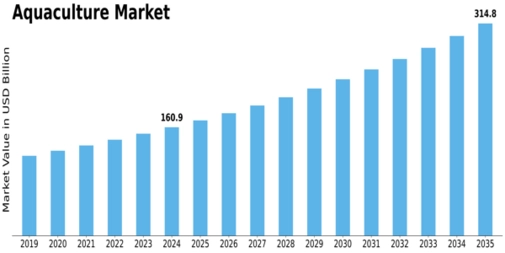
The aquaculture market story is one of evolution—moving from traditional pond-based operations to modern, technology-enabled farms. With a global valuation of around US $160.9 billion in 2024 and a predicted surge to approximately US $314.8 billion by 2035, the sector is scaling rapidly.
Industry Overview
Historically, many aquaculture operations were small-scale, labour-intensive and heavily reliant on natural water bodies. Today, however, advanced farms employ recirculating aquaculture systems (RAS), automated feeding, real-time monitoring and improved genetics. These shifts respond to multiple pressures: the need for higher productivity, environmental concerns and the expectation for consistent quality and supply.
Key Players’ Role
Key companies are at the forefront of the shift. AquaBounty Technologies uses biotechnology to develop fish that mature more quickly and efficiently. Meanwhile, Dainichi Corporation invests in aquafeed that is tailored for different species, optimising growth and health outcomes.These firms—together with others like Mowi and Grieg Seafood—are leveraging global supply networks, scaling operations and emphasising sustainability to stay ahead in the increasingly complex aquaculture landscape.
Segmentation Growth
Important segmentation trends:
-
By environment: Freshwater remains dominant, valued at ~US $80 billion in 2024 and set to rise to about US $165 billion by 2035.Marine water and brackish water systems complement that share.
-
By type: ‘Fish’ continues to have the largest volume; however, other categories like crustaceans and molluscs are increasing their footprint as consumers seek variety and value.
-
By region: Asia-Pacific leads with around US $70 billion in 2024, reflecting strong regional demand, favourable conditions and expanding infrastructure. North America and Europe are notable for sophisticated, technology-driven systems.
Market Outlook
The market’s 6.29 % CAGR through 2035 is a solid indicator of long-term growth. Several drivers underpin this outlook: growing global seafood consumption, increasing investment in farm infrastructure and technology, and rising awareness of the environmental benefits of well-managed aquaculture. For businesses, success will increasingly depend on efficiency, traceability and sustainable credentials—not just volume. Emerging opportunities include: land-based high-density farms, premium niche species, integrated systems combining aquaculture with agriculture (e.g., aquaponics) and feed innovation to reduce environmental footprint.

 English
 Arabic
 French
 Spanish
 Portuguese
 Deutsch
 Turkish
 Dutch
Dutch
 Italiano
 Russian
 Portuguese (Brazil)
 Greek
Greek