
U.S., Europe, and Japan AI in Endoscopy Market: Unlocking Next-Generation Diagnostics with Intelligent Automation
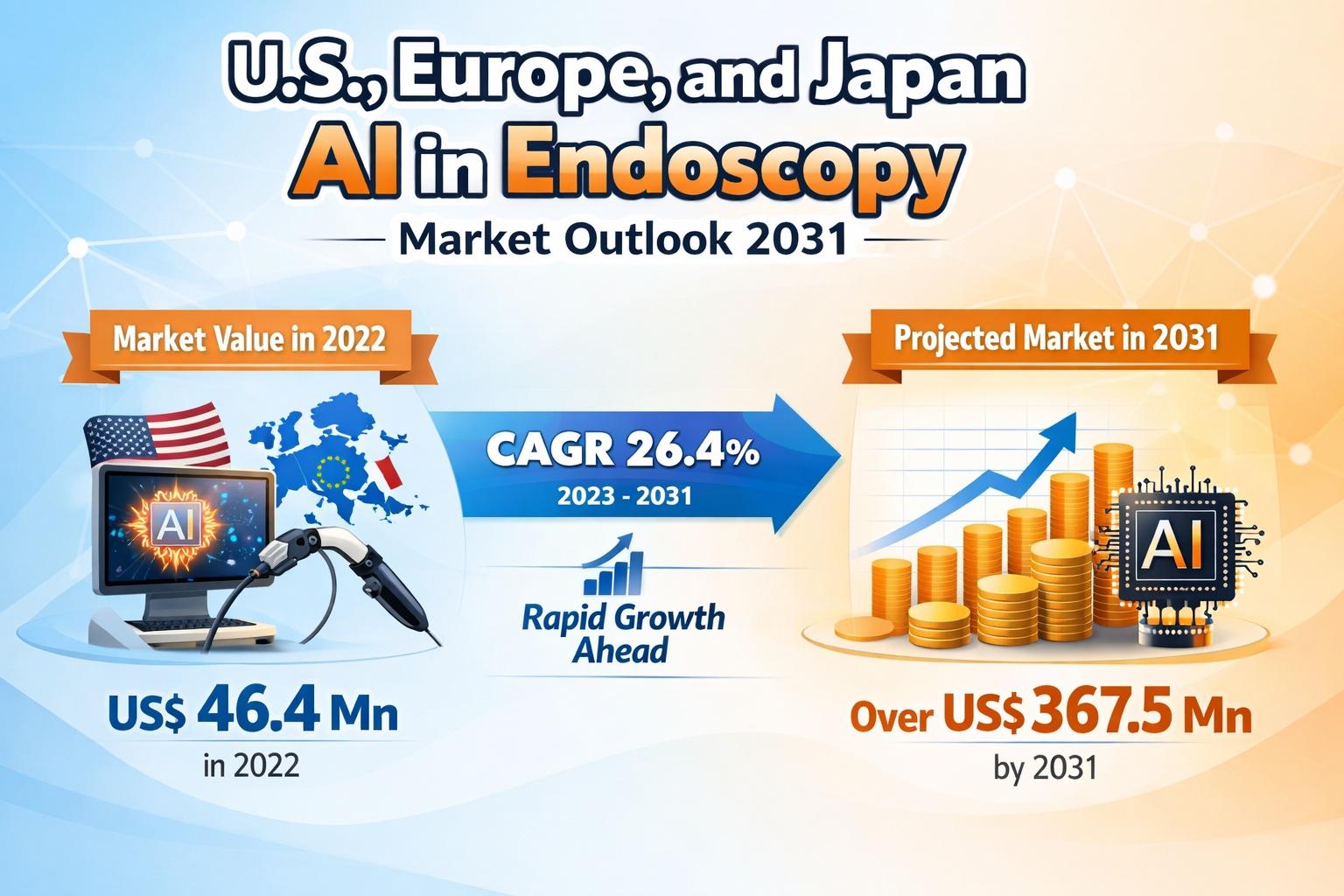
The U.S., Europe, and Japan AI in Endoscopy Market is witnessing unprecedented growth as artificial intelligence (AI) continues to redefine the landscape of gastrointestinal diagnostics and therapeutic procedures. With a market valuation of US$ 46.4 Mn in 2022 and a projected value exceeding US$ 367.5 Mn by 2031, the industry is expected to expand at a remarkable CAGR of 26.4% during the forecast period. This rapid expansion reflects the growing reliance on AI-powered solutions to enhance clinical precision, reduce diagnostic errors, and streamline endoscopic workflows.
AI integration into endoscopy is not merely an incremental improvement—it represents a paradigm shift in how gastrointestinal diseases are detected and managed. By combining machine learning, computer vision, and real-time analytics, AI is empowering clinicians with tools that significantly improve detection rates and diagnostic confidence.
Transformational Role of AI in Endoscopy
Endoscopy has long been a cornerstone of gastrointestinal diagnostics, enabling direct visualization of internal organs. However, traditional methods are limited by human factors such as fatigue, variability in expertise, and the potential to miss subtle abnormalities.
AI addresses these limitations by acting as a “second observer” during procedures. Advanced algorithms continuously analyze endoscopic video feeds, identifying suspicious lesions, polyps, and bleeding sites in real time. This augmentation enhances the accuracy and consistency of diagnoses.
In regions such as the United States, Europe, and Japan, the adoption of AI in endoscopy is accelerating due to strong healthcare infrastructure, high patient volumes, and a proactive approach to adopting cutting-edge technologies.
Market Growth Drivers
Rising Incidence of Colorectal Cancer
Colorectal cancer remains a leading cause of cancer-related deaths globally. Early detection is critical for improving survival rates, and endoscopy plays a vital role in screening and diagnosis.
AI-enhanced systems significantly improve adenoma detection rates (ADR), a key performance metric in colonoscopy. By identifying precancerous polyps with greater accuracy, AI helps reduce the incidence and mortality of colorectal cancer.
Increasing Demand for Efficient Healthcare Delivery
Healthcare systems are under constant pressure to improve efficiency while maintaining high standards of care. AI in endoscopy enables faster procedures, reduces diagnostic errors, and enhances workflow efficiency.
Real-time decision support allows clinicians to make immediate and accurate judgments, minimizing the need for repeat procedures and improving patient satisfaction.
Technological Advancements
Rapid advancements in AI technologies, including deep learning and neural networks, are driving innovation in endoscopy. High-definition imaging combined with AI analytics provides unparalleled diagnostic capabilities.
Features such as automated lesion detection, classification, and risk stratification are becoming integral to modern endoscopic systems.
Market Segmentation Insights
By Type
The market is segmented into products and services. Products dominate the market, encompassing AI-integrated endoscopes and software platforms. Services, including training and maintenance, are gaining importance as healthcare providers seek comprehensive solutions.
By CAD Technology
- CADe (Computer-Aided Detection): Identifies abnormalities during procedures
- CADx (Computer-Aided Diagnosis): Provides detailed characterization of detected lesions
- CADe/CADx Systems: Offer integrated solutions for detection and diagnosis
CADe systems hold the largest market share due to their effectiveness in improving detection rates during colonoscopy.
By Application
Applications of AI in endoscopy include:
- Polyps Detection
- Bleeding Detection
- Early Cancer Identification
- Cancer Staging
- Polyp Sizing
- Additional diagnostic functions
Polyps detection remains the dominant application segment, driven by the need for early cancer prevention.
By End-user
- Hospitals
- Ambulatory Surgical Centers
- Specialty Clinics
Hospitals account for the largest share, owing to their advanced infrastructure and high patient volumes. However, ambulatory surgical centers are emerging as a fast-growing segment due to their cost efficiency.
Regional Landscape
United States
The United States leads the market with a high adoption rate of AI technologies in healthcare. The country performs millions of endoscopic procedures annually, providing a strong foundation for AI integration.
Supportive regulatory frameworks and innovation-friendly policies are accelerating the adoption of AI-based solutions. The widespread use of CADe systems highlights the country’s commitment to improving diagnostic outcomes.
Europe
Europe is experiencing robust growth in the AI in endoscopy market, driven by increasing healthcare investments and a strong focus on innovation. Countries across the region are adopting AI technologies to enhance diagnostic accuracy and patient care.
Collaborations between healthcare providers and technology companies are fostering innovation and driving market expansion.
Japan
Japan’s aging population and high prevalence of gastrointestinal diseases are key factors driving the adoption of AI in endoscopy. The country’s advanced technological capabilities further support the development and implementation of AI solutions.
Japan is at the forefront of integrating AI into clinical practice, with a focus on improving diagnostic accuracy and patient outcomes.
Competitive Landscape
The market is characterized by intense competition, with leading players focusing on innovation and strategic partnerships to strengthen their positions.
Key players include:
- Medtronic plc
- Wision A.I.
- Olympus Corporation
- Fujifilm Corporation
- Pentax Corporation
- NEC Corporation
- Magentiq Eye Inc.
- Iterative Scopes
- ENDOANGEL Medical Technology Co., Ltd.
- Waycen Inc.
These companies are investing heavily in research and development to introduce innovative products and expand their market presence globally.
Emerging Trends
AI-Assisted Real-Time Diagnostics
Real-time AI assistance is becoming a standard feature in modern endoscopy systems. These systems provide instant feedback, enabling clinicians to detect abnormalities with greater accuracy.
Integration with Robotics
The integration of AI with robotic systems is opening new possibilities in minimally invasive procedures. Robotic-assisted endoscopy combined with AI can enhance precision and control.
Data-Driven Healthcare
AI systems generate vast amounts of data that can be used for predictive analytics and clinical decision-making. This data-driven approach is transforming healthcare delivery.
Personalized Treatment Approaches
AI enables personalized medicine by analyzing patient-specific data and tailoring treatment plans accordingly. This approach improves patient outcomes and reduces healthcare costs.
Challenges and Restraints
Despite its promising growth, the market faces several challenges:
- High initial investment costs
- Regulatory complexities
- Data privacy concerns
- Limited awareness in certain regions
Overcoming these challenges will require collaborative efforts between industry stakeholders, regulatory bodies, and healthcare providers.
Opportunities for Growth
Expansion of AI Applications
The scope of AI in endoscopy is expanding beyond detection to include diagnosis, treatment planning, and monitoring. This creates new opportunities for innovation and market growth.
Increasing Collaborations
Partnerships between technology companies and healthcare providers are accelerating the development and adoption of AI solutions.
Advancements in Cloud Computing
Cloud-based AI platforms are enabling scalable and cost-effective solutions, facilitating widespread adoption.
Future Outlook
The future of the U.S., Europe, and Japan AI in Endoscopy Market is highly promising. As AI technologies continue to evolve, their integration into clinical workflows will become more seamless and widespread.
Key trends shaping the future include:
- Increased adoption of AI across healthcare facilities
- Continuous innovation in AI technologies
- Expansion of AI applications in various medical fields
- Enhanced collaboration between industry players
The convergence of AI and endoscopy is set to revolutionize gastrointestinal healthcare, improving diagnostic accuracy and patient outcomes.
Conclusion
The U.S., Europe, and Japan AI in Endoscopy Market is at the forefront of a technological revolution in healthcare. With rapid advancements in AI and increasing demand for accurate diagnostics, the market is poised for significant growth.
By enhancing detection rates, improving efficiency, and enabling personalized treatment, AI is transforming endoscopic procedures and setting new standards in patient care.

 English
 Arabic
 French
 Spanish
 Deutsch
 Turkish
 Dutch
Dutch
 Italiano
 Russian
 Romaian
 Portuguese (Brazil)
 Greek
Greek