
Acrylic Acid Esters Market: Innovation, Sustainability Trends, and Competitive Strategies Shaping the Future
The acrylic acid esters market is witnessing a dynamic transformation as industries worldwide seek materials that combine performance, durability, and sustainability. Acrylic acid esters, derived from acrylic acid, are essential building blocks in the production of a wide range of industrial and consumer products, including adhesives, coatings, plastics, textiles, and superabsorbent polymers. Their adaptability and functional properties make them critical to modern manufacturing and infrastructure development.
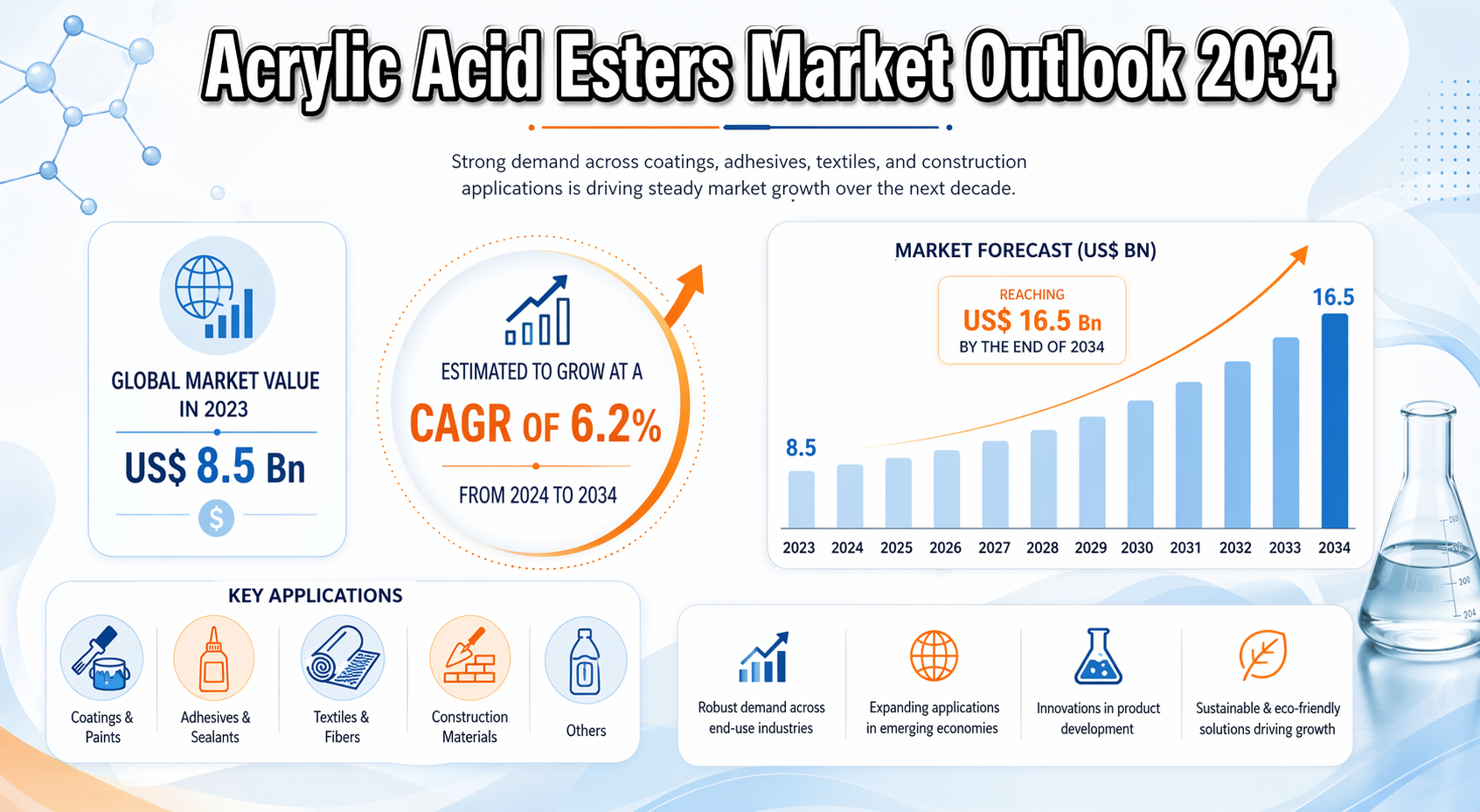
With a global market valuation of US$ 8.5 billion in 2023, the acrylic acid esters market is projected to grow steadily at a CAGR of 6.2% from 2024 to 2034, reaching approximately US$ 16.5 billion by the end of the forecast period. This growth is being driven by a combination of industrial expansion, rising consumer demand, and increasing investments in sustainable technologies.
A key driver of the market is the rising demand for superabsorbent polymers (SAPs), which are primarily used in personal hygiene products. These polymers, produced using acrylic acid esters, have the ability to absorb and retain large volumes of liquid, making them ideal for products such as baby diapers, adult incontinence items, and sanitary napkins. As global awareness of hygiene improves and disposable incomes rise, especially in developing economies, the consumption of these products is increasing significantly.
In addition to personal care, the agricultural sector is emerging as a promising area for SAP applications. Farmers are increasingly using superabsorbent polymers to improve soil water retention and enhance crop yields. This is particularly important in regions experiencing water scarcity, where efficient water management is critical. The growing emphasis on sustainable agriculture is expected to further drive the adoption of acrylic-based SAPs.
The paints and coatings industry remains one of the largest consumers of acrylic acid esters. These esters are used to produce coatings that offer excellent adhesion, durability, UV resistance, and aesthetic appeal. They are widely applied in construction, automotive, and industrial sectors. The ongoing expansion of infrastructure projects, coupled with the increasing demand for high-quality finishes, is fueling the growth of this segment.
In the construction industry, acrylic acid esters are used in adhesives, sealants, and protective coatings that enhance the performance and lifespan of buildings and infrastructure. Rapid urbanization and population growth, particularly in Asia Pacific, are leading to increased construction activities. Government investments in housing and infrastructure projects are also contributing to the demand for acrylic-based materials.
From a product perspective, the market includes several types of acrylic acid esters such as butyl acrylate, methyl acrylate, ethyl acrylate, and 2-ethylhexyl acrylate. Each type offers unique properties tailored to specific applications. Butyl acrylate is widely used in coatings and adhesives due to its flexibility and resistance to environmental factors. Methyl acrylate is known for its high reactivity and is used in the production of resins and fibers. Ethyl acrylate and 2-ethylhexyl acrylate provide enhanced durability and weather resistance, making them suitable for demanding applications.
The application landscape of acrylic acid esters is extensive. In adhesives and sealants, they are used to produce pressure-sensitive adhesives that are essential in packaging, labeling, and electronics assembly. These adhesives offer strong bonding and long-term reliability. In coatings, acrylic esters are used to create paints that provide protection against environmental damage while maintaining visual appeal.
Plastic additives represent another important application area, where acrylic esters are used to improve the flexibility, impact resistance, and thermal stability of plastic materials. In the paper industry, they are used as coatings and adhesives to enhance paper strength and printability. In textile processing, acrylic esters are employed to impart properties such as water resistance, heat resistance, and UV protection, improving the durability and functionality of fabrics.
Regionally, Asia Pacific leads the acrylic acid esters market, driven by rapid industrialization, urbanization, and infrastructure development. Countries such as China, India, and Japan are major contributors to regional growth. The expanding middle class and increasing consumer spending in these countries are driving demand for products that utilize acrylic esters, including personal care items, construction materials, and automotive components.
North America and Europe also play significant roles in the market, characterized by advanced manufacturing capabilities and a strong focus on sustainability. In these regions, regulatory frameworks are encouraging the use of environmentally friendly materials, leading to increased demand for low-VOC and water-based coatings. This has prompted companies to invest in research and development to create sustainable acrylic ester products.
Sustainability is becoming a central theme in the acrylic acid esters market. Companies are increasingly focusing on reducing their environmental impact by adopting cleaner production processes and developing bio-based alternatives. Bio-based acrylic esters, derived from renewable resources, offer similar performance characteristics while reducing reliance on fossil fuels. This shift toward sustainable solutions is expected to play a crucial role in shaping the future of the market.
The competitive landscape is marked by the presence of several global players who are actively engaged in innovation, expansion, and strategic partnerships. Leading companies such as Arkema, BASF SE, TOAGOSEI Co., Ltd., Sinochem Holdings Corporation Ltd., LG Chem Ltd., Mitsubishi Chemical Group Corporation, Nippon Shokubai Co., Ltd., and Dow are investing in advanced technologies to enhance product performance and sustainability.
These companies are focusing on developing products that offer improved clarity, flexibility, and resistance to environmental factors. They are also expanding their production capacities to meet growing demand, particularly in emerging markets. Strategic collaborations and partnerships are enabling companies to strengthen their market positions and explore new opportunities.
Recent developments in the industry highlight the importance of sustainability and efficiency. Companies are adopting innovative logistics solutions to reduce greenhouse gas emissions associated with transportation. Investments in new production facilities are also helping to improve operational efficiency and meet regional demand. These initiatives reflect the industry's commitment to sustainable growth and environmental responsibility.
Despite the positive outlook, the acrylic acid esters market faces several challenges. Fluctuations in raw material prices, particularly acrylic acid, can impact production costs and profitability. Environmental concerns and regulatory pressures are also increasing, requiring companies to adopt sustainable practices and comply with stringent guidelines.
However, these challenges also present opportunities for innovation. The development of bio-based and eco-friendly products is expected to gain momentum, driven by regulatory requirements and consumer preferences. Advances in material science are enabling the creation of high-performance products that meet the evolving needs of various industries.
Emerging applications in sectors such as electric vehicles, renewable energy, and smart infrastructure are expected to create new growth opportunities for the acrylic acid esters market. These industries require materials that offer durability, efficiency, and sustainability, making acrylic esters an ideal choice.
In conclusion, the acrylic acid esters market is poised for sustained growth, supported by strong demand across multiple industries, ongoing technological advancements, and a growing emphasis on sustainability. Companies that focus on innovation and environmental responsibility are likely to gain a competitive edge in this evolving market landscape.

 English
 Arabic
 Spanish
 Portuguese
 Deutsch
 Turkish
 Dutch
Dutch
 Italiano
 Russian
 Romaian
 Portuguese (Brazil)
 Greek
Greek