
Heart Pumps Market Poised for Transformational Growth Amid Rising Cardiovascular Burden and Technological Innovation (2023–2031)
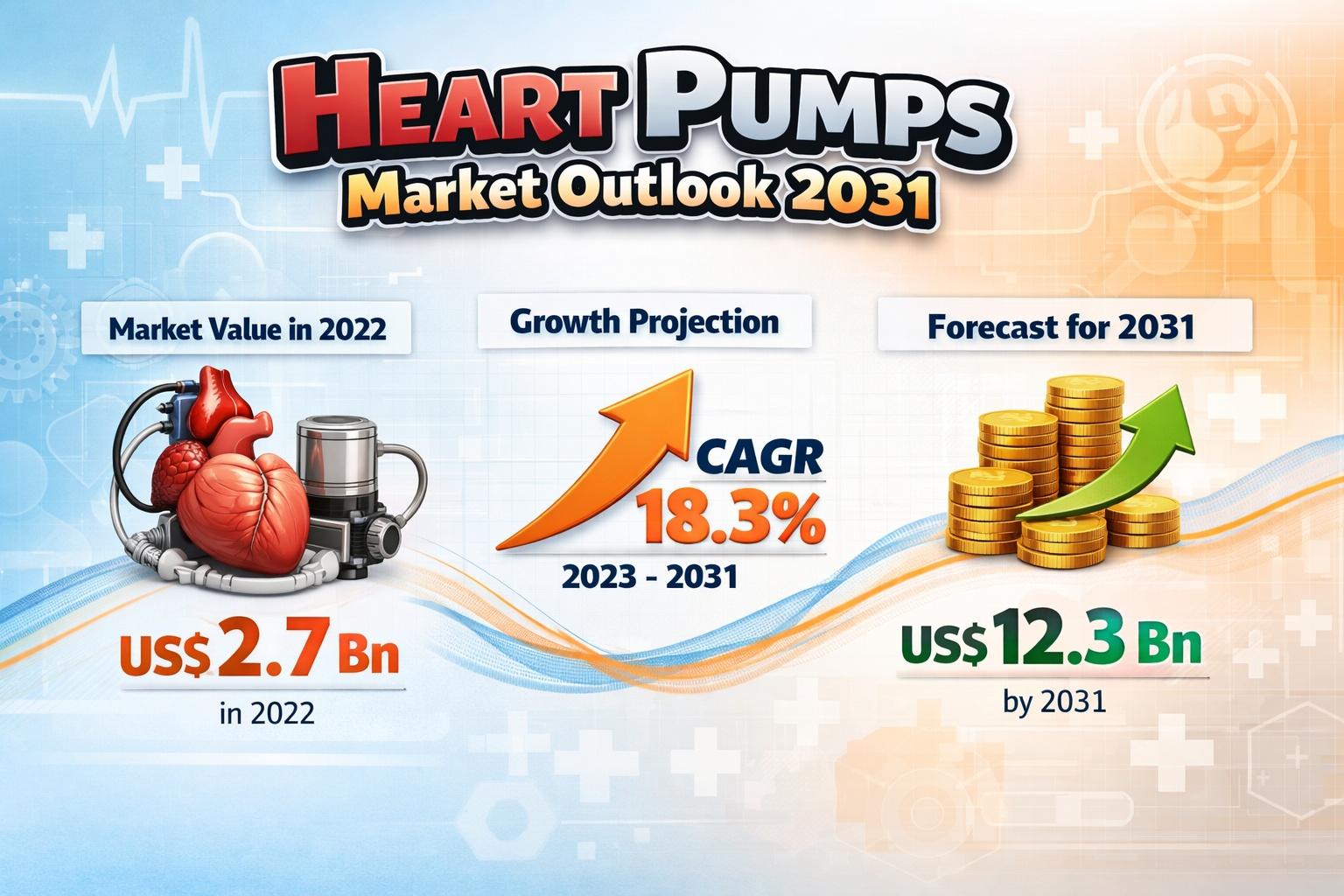
The global healthcare industry is undergoing a paradigm shift as cardiovascular diseases (CVDs) continue to claim millions of lives annually. At the center of this transformation lies the rapidly evolving heart pumps market, which is emerging as a cornerstone of advanced cardiac care. Valued at US$ 2.7 billion in 2022, the global heart pumps industry is projected to expand at a remarkable CAGR of 18.3% from 2023 to 2031, reaching an estimated US$ 12.3 billion by the end of the forecast period. This growth trajectory reflects not only the escalating prevalence of heart failure but also advancements in mechanical circulatory support technologies and heightened awareness regarding cardiac health.
Market Overview
Heart pumps are mechanical medical devices engineered to either support or completely replace the pumping function of a failing heart. These devices are primarily utilized in patients suffering from advanced or end-stage heart failure, where conventional medical therapies fail to deliver adequate cardiac output.
The market broadly encompasses:
-
Intra-aortic Balloon Pumps (IABP)
-
Ventricular Assist Devices (VADs)
-
Left Ventricular Assist Devices (LVAD)
-
Right Ventricular Assist Devices (RVAD)
-
Biventricular Assist Devices (BVAD)
-
-
Total Artificial Hearts (TAH)
These devices are employed under various therapeutic strategies, particularly Bridge-to-Candidacy (BTC) and Bridge-to-Transplant (BTT), offering either temporary or long-term support depending on patient eligibility for transplantation.
The increasing clinical acceptance of mechanical circulatory support systems has positioned heart pumps as a viable and, in many cases, life-saving intervention.
Rising Cardiovascular Disease Burden Driving Demand
One of the most significant forces propelling the heart pumps market is the alarming rise in cardiovascular diseases worldwide. Sedentary lifestyles, rising obesity levels, unhealthy dietary habits, chronic stress, and environmental pollution have collectively intensified the incidence of heart-related ailments.
According to the World Health Organization, cardiovascular diseases account for nearly 40% of global premature deaths due to non-communicable diseases. Similarly, data from the CDC Foundation indicate that approximately one in three adults in the United States—nearly 86 million people—suffer from at least one form of cardiovascular condition.
Furthermore, the British Heart Foundation estimates that 20.5 million deaths were attributed to cardiovascular diseases in 2021 alone.
The aging global population further compounds this challenge. Older individuals are at significantly higher risk of heart failure, and as life expectancy increases, the pool of patients requiring advanced cardiac interventions is expanding steadily. Consequently, the demand for heart pumps as both temporary and permanent solutions is accelerating.
Technological Advancements Reshaping the Landscape
Innovation is at the heart of growth within the heart pumps market. Over the past decade, manufacturers have focused heavily on improving device miniaturization, battery longevity, biocompatibility, and real-time monitoring capabilities.
Modern heart pumps are:
-
Smaller and more compact
-
Designed with extended battery life
-
Equipped with remote monitoring systems
-
Engineered with improved flow dynamics to reduce complications
Flow pump technologies, including centrifugal, axial, and mixed flow pumps, are gaining prominence due to their ability to optimize blood flow while minimizing hemolysis and thrombosis risks.
Emerging players are also investing in the development of next-generation total artificial hearts that offer enhanced durability and improved patient comfort. These innovations are expected to expand patient eligibility and reduce hospitalization duration.
In June 2023, Magenta Medical initiated early-stage feasibility studies to develop what it describes as the world’s smallest heart pump, highlighting the race toward minimally invasive and highly efficient designs. Similarly, BiVACOR received substantial funding from the Australian government to enhance its Total Artificial Heart technology by reducing controller size and weight, thereby improving patient mobility and quality of life.
Expanding Therapeutic Applications: BTC and BTT
Therapeutic strategies are central to understanding market segmentation.
Bridge-to-Transplant (BTT)
In BTT therapy, heart pumps support patients awaiting donor heart availability. Given the global shortage of donor organs, mechanical circulatory support devices have become critical in sustaining patients during prolonged waiting periods.
Bridge-to-Candidacy (BTC)
BTC therapy involves temporary mechanical support while clinicians evaluate whether a patient qualifies for a transplant. This approach allows stabilization and improvement of organ function, thereby increasing transplant eligibility.
The growing reliance on these strategies reflects an evolving treatment paradigm in advanced heart failure management.
Increased Awareness and Preventive Healthcare Momentum
Another key catalyst fueling market growth is rising awareness regarding heart health. Governments and healthcare institutions worldwide are conducting public awareness campaigns to promote early diagnosis and preventive measures.
The COVID-19 pandemic significantly amplified health consciousness. Studies revealed that individuals with pre-existing cardiovascular conditions were more susceptible to severe illness. This heightened awareness has driven demand for diagnostic screenings and advanced treatment options, including mechanical heart support systems.
Financial incentives, research grants, and collaborative healthcare initiatives are further encouraging adoption and innovation in heart pump technologies.
Regional Insights
North America: Dominant Market Leader
North America held the largest share of the global heart pumps market in 2022. Several factors underpin this dominance:
-
Advanced healthcare infrastructure
-
High awareness of cardiac care technologies
-
Substantial R&D investments
-
Favorable reimbursement policies
The United States, in particular, represents a major revenue contributor. Cardiovascular healthcare expenditures are immense, with projections indicating that annual costs related to heart diseases could reach US$ 818 billion by 2030.
The region’s strong clinical research ecosystem and early adoption of innovative devices position it as a key hub for market growth.
Asia Pacific: Emerging High-Growth Region
The Asia Pacific region is expected to register steady and significant growth between 2023 and 2031. Rapid urbanization, increasing healthcare expenditure, and growing incidence of cardiovascular diseases are primary growth drivers.
India and China, with their vast populations, represent substantial untapped opportunities. According to the All India Institute of Medical Sciences, strokes are the second most common cause of death in India, with a stroke-related fatality occurring every four minutes.
As healthcare access improves and awareness campaigns intensify, demand for advanced cardiac support devices is projected to rise considerably in the region.
Europe and Other Regions
Europe also maintains a strong market presence, supported by government-backed healthcare systems and established cardiac research programs. Meanwhile, Latin America and the Middle East & Africa are gradually expanding their cardiac care infrastructure, opening new avenues for market penetration.
Competitive Landscape
The heart pumps market is characterized by a mix of established multinational corporations and emerging innovators. Key players are focusing on product diversification, strategic collaborations, and mergers and acquisitions to enhance market share.
Prominent companies operating in the market include:
-
SynCardia Systems, LLC
-
Berlin Heart GmbH
-
Jarvik Heart Inc.
-
Calon Cardio-Technology Ltd.
-
Teleflex Incorporated
-
Abbott Laboratories
-
Medtronic plc
These companies are investing significantly in R&D to develop implantable heart pump devices that are compact, energy-efficient, and capable of long-term operation.
Research collaborations between academia and industry players are also shaping innovation trajectories, particularly in biomaterials and wireless monitoring integration.
Market Segmentation Insights
By Product
-
Intra-aortic Balloon Pumps
-
Ventricular Assist Devices (LVAD, RVAD, BVAD)
-
Total Artificial Heart
Among these, LVADs account for a substantial market share due to their widespread application in left ventricular failure, the most common form of advanced heart failure.
By Flow Regime
-
Centrifugal Flow Pump (CFP)
-
Axial Flow Pump (AFP)
-
Mixed Flow Pump (MFP)
Centrifugal flow pumps are gaining popularity owing to reduced mechanical wear and improved hemocompatibility.
By Location
-
Implantable Devices
-
Extracorporeal Devices
Implantable heart pumps are expected to dominate future growth due to improved patient mobility and enhanced lifestyle outcomes.
By End-User
-
Hospitals
-
Ambulatory Surgical Centers
-
Specialty Clinics
-
Others
Hospitals remain the primary end-users, given the complexity of surgical implantation and postoperative management requirements.
Challenges and Restraints
Despite strong growth prospects, the heart pumps market faces several challenges:
-
High device costs
-
Risk of complications such as infection and thrombosis
-
Limited donor organ availability affecting BTT strategies
-
Strict regulatory approval processes
Additionally, disparities in healthcare access across low- and middle-income countries may limit widespread adoption.
However, ongoing technological improvements aimed at reducing adverse events and manufacturing costs are expected to mitigate these challenges over time.
Future Outlook (2023–2031)
Looking ahead, the heart pumps market is poised for transformative expansion. Technological convergence—combining artificial intelligence, IoT-enabled remote monitoring, and advanced biomaterials—is expected to redefine patient care.
The development of fully implantable, wireless-powered artificial hearts may become a game-changing milestone within the forecast period. Furthermore, enhanced public-private partnerships and government funding initiatives will likely accelerate innovation pipelines.
With cardiovascular diseases continuing to rise globally and healthcare systems prioritizing life-saving technologies, heart pumps are transitioning from niche interventions to mainstream advanced cardiac therapies.

 English
 Arabic
 French
 Spanish
 Portuguese
 Deutsch
 Turkish
 Dutch
Dutch
 Russian
 Romaian
 Portuguese (Brazil)
 Greek
Greek