
Autotransfusion Devices Market Poised for Steady Growth Amid Rising Surgical Volumes and Technological Advancements
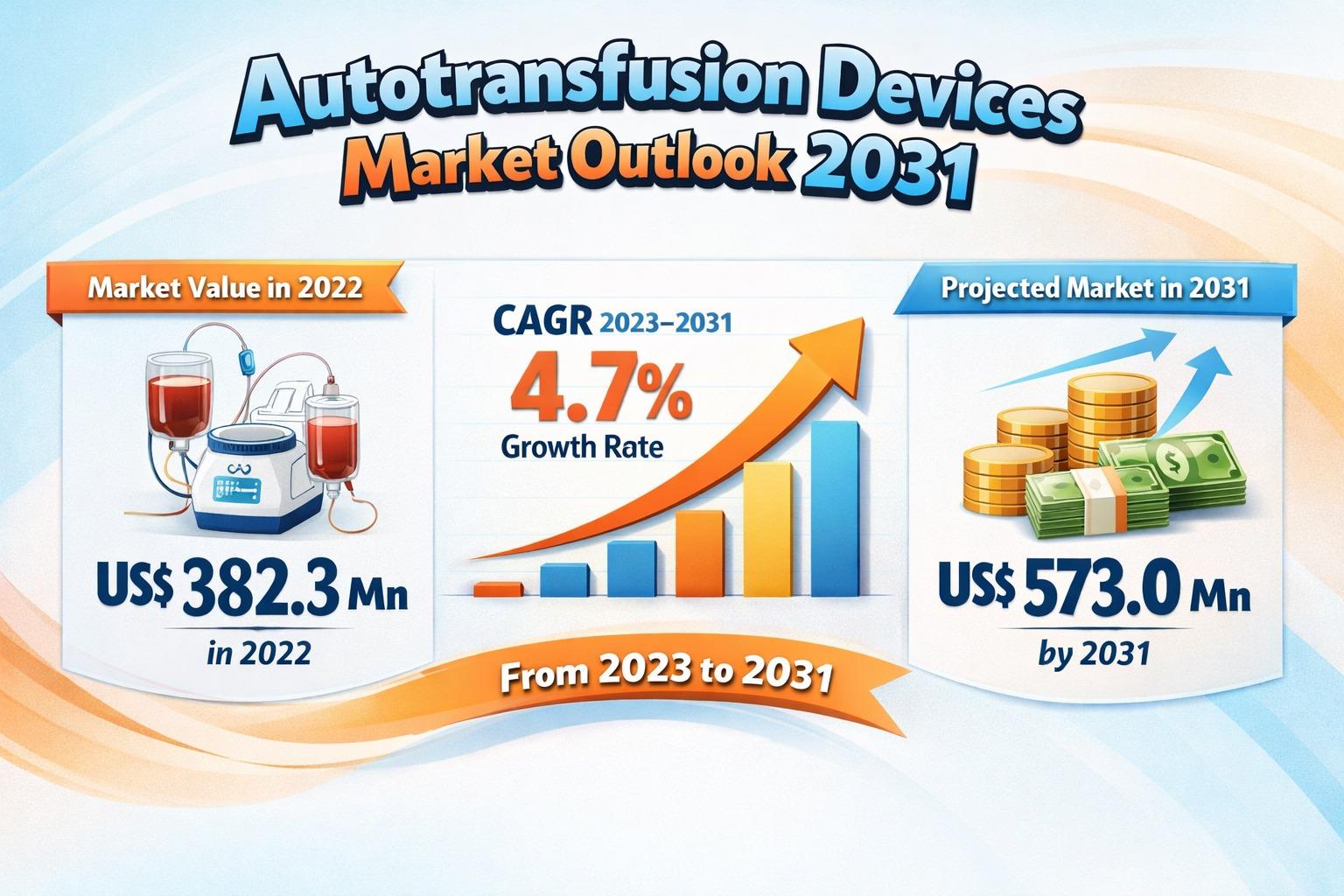
The global healthcare industry is undergoing a significant transformation driven by rising chronic disease prevalence, growing surgical volumes, and increasing emphasis on patient safety. Within this evolving landscape, the Autotransfusion Devices Market is emerging as a vital segment supporting modern surgical care. Valued at US$ 382.3 million in 2022, the market is projected to reach US$ 573.0 million by 2031, expanding at a compound annual growth rate (CAGR) of 4.7% during the forecast period from 2023 to 2031.
Autotransfusion devices play a critical role in blood management strategies, particularly during surgical procedures that involve substantial blood loss. As healthcare systems worldwide grapple with declining availability of donor blood and the risks associated with allogeneic transfusions, autotransfusion technology is gaining widespread acceptance. The integration of advanced software, improved filtration mechanisms, and user-friendly designs is further strengthening the market’s growth trajectory.
Understanding Autotransfusion and Its Clinical Importance
Autotransfusion refers to the process of collecting and reinfusing a patient’s own blood during or after surgery, instead of relying on banked donor blood. This technique significantly reduces the risk of transfusion-related infections, immunological reactions, and blood-type incompatibility.
Autotransfusion devices typically consist of a blood collection reservoir, filtration system, processing unit, and transfusion bag. These systems are designed to collect shed blood during surgery, remove contaminants and debris, and return purified red blood cells back to the patient.
The clinical advantages of autotransfusion include:
-
Reduced risk of infection transmission
-
Elimination of isosensitization
-
Improved oxygen-carrying capacity
-
Decreased reliance on allogeneic blood supply
-
Enhanced postoperative recovery
These benefits have positioned autotransfusion devices as indispensable tools in high-blood-loss procedures such as cardiac surgeries, orthopedic operations, trauma interventions, neurosurgeries, and gynecological procedures.
Key Market Drivers
1. Rising Prevalence of Chronic Diseases
Chronic diseases remain one of the leading causes of disability and mortality worldwide. Cardiovascular disorders, orthopedic degenerative conditions, and cancer often necessitate surgical interventions. As the global population ages, the incidence of chronic illnesses continues to climb, directly contributing to increased surgical procedures.
In countries like India, studies indicate that over 40% of adults and elderly individuals suffer from at least one chronic condition. Similarly, heart disease remains a leading cause of death in the United States, accounting for nearly 695,000 deaths in 2021. The high burden of cardiovascular diseases significantly drives cardiac surgeries, thereby increasing demand for autotransfusion devices.
2. Growth in Surgical Procedures
The steady rise in surgical volumes is a fundamental growth catalyst for the Autotransfusion Devices Market. Cardiac surgeries, valve replacements, coronary artery bypass grafting (CABG), and orthopedic joint replacements are performed in increasing numbers globally.
Data from Germany’s cardiac surgery registry reported more than 162,000 procedures in 2022 alone, including nearly 28,000 isolated coronary artery bypass grafting operations. These procedures often involve substantial blood loss, necessitating efficient intraoperative blood management systems.
Autotransfusion devices ensure hemodynamic stability during surgery while minimizing exposure to donor blood, making them increasingly preferred by surgeons and healthcare providers.
3. Decreasing Availability of Allogeneic Blood
Global blood banks face periodic shortages due to declining donor participation, demographic shifts, and stringent screening requirements. Additionally, logistical challenges in blood storage and transportation can limit supply.
Autotransfusion serves as an effective solution by utilizing the patient’s own blood, reducing pressure on blood banks. In emergency settings and regions with limited donor availability, autotransfusion becomes especially valuable.
4. Increasing Awareness of Blood Conservation
Blood conservation programs have gained prominence in modern healthcare systems. Hospitals are implementing patient blood management (PBM) strategies aimed at reducing unnecessary transfusions and optimizing patient outcomes.
Autotransfusion aligns seamlessly with these initiatives, as it helps preserve blood resources while ensuring patient safety. Growing awareness among surgeons, anesthesiologists, and hospital administrators regarding the clinical and economic benefits of blood conservation is supporting market expansion.
Technological Advancements Enhancing Market Growth
Continuous innovation is transforming autotransfusion technology. Modern systems are becoming more compact, automated, and efficient. Enhanced filtration systems ensure higher purity levels of reinfused blood, while improved software interfaces simplify device operation.
For instance, recent regulatory approvals for next-generation software upgrades in autotransfusion systems have introduced intelligent control features that optimize blood processing efficiency. These advancements enhance user experience, reduce manual intervention, and improve procedural accuracy.
Automation in blood salvage processes minimizes human error and increases procedural speed, which is particularly crucial in emergency surgeries. Furthermore, improvements in double-integrated filtration systems ensure safer reinfusion by removing contaminants, fat particles, and debris.
As healthcare facilities increasingly prioritize operational efficiency and patient safety, technologically advanced autotransfusion devices are gaining competitive advantage.
Market Segmentation Analysis
By Product Type
The market is segmented into:
-
On-pump transfusion devices
-
Off-pump transfusion devices
On-pump transfusion devices are commonly used during cardiopulmonary bypass surgeries. These systems integrate seamlessly with heart-lung machines and are extensively employed in cardiac procedures.
Off-pump transfusion devices are used in surgeries where cardiopulmonary bypass is not required. These devices are gaining popularity due to their flexibility and ease of use in various surgical specialties.
While on-pump devices dominate cardiac applications, off-pump systems are witnessing growing adoption across orthopedics, trauma care, and ambulatory settings.
By End-user
The primary end-users include:
-
Hospitals
-
Ambulatory Surgical Centers (ASCs)
-
Cardiac Research Centers
Hospitals account for a significant share of the market due to the high volume of complex surgeries performed in these facilities. However, ambulatory surgical centers are emerging as a high-growth segment.
ASCs offer specialized surgical services, advanced operating rooms, and lower infection risks compared to traditional hospital settings. The shift toward minimally invasive procedures and outpatient surgeries is boosting autotransfusion device adoption in ASCs.
Cardiac research centers also represent a niche but important segment, particularly in developed markets with strong research infrastructure.
Regional Outlook
North America
North America held the largest market share in 2022. The region benefits from advanced healthcare infrastructure, high healthcare expenditure, and a substantial cardiac patient population.
The United States leads regional growth due to increasing cardiac procedures, strong adoption of advanced medical technologies, and well-established blood management programs. Rising awareness of transfusion-related complications further drives demand for autotransfusion systems.
Europe
Europe represents another significant market, driven by increasing cardiac surgeries and strong regulatory frameworks promoting patient safety. Countries such as Germany, the U.K., France, and Italy have robust surgical volumes, contributing to steady demand.
Asia Pacific
The Asia Pacific region is expected to witness substantial growth during the forecast period. Rapid urbanization, expanding healthcare infrastructure, rising medical tourism, and growing prevalence of chronic diseases are key growth drivers.
Countries such as China and India are experiencing significant increases in surgical procedures, creating lucrative opportunities for market players.
Latin America and Middle East & Africa
Although relatively smaller in market size, these regions are gradually adopting advanced surgical technologies. Improvements in healthcare infrastructure and increasing government initiatives to modernize medical facilities are expected to support future growth.
Competitive Landscape
The Autotransfusion Devices Market is moderately consolidated, with several key players competing through innovation, product launches, and strategic collaborations. Prominent companies focus on expanding their geographic presence and strengthening their product portfolios.
Market participants are actively engaging in mergers, acquisitions, and partnerships to enhance technological capabilities and enter emerging markets. Continuous investment in research and development remains a critical strategy for maintaining competitive advantage.
The introduction of automated sponge-blood recovery systems and intelligent software upgrades demonstrates the industry's commitment to improving efficiency and patient outcomes.
Challenges and Restraints
Despite positive growth prospects, the market faces certain challenges:
-
High initial cost of autotransfusion devices
-
Requirement for trained professionals
-
Regulatory complexities
-
Limited adoption in low-income regions
Cost sensitivity in developing countries may hinder widespread adoption. Additionally, smaller healthcare facilities may lack the necessary expertise or infrastructure to operate advanced autotransfusion systems.
However, as device manufacturers introduce more cost-effective models and training programs, these barriers are expected to gradually diminish.
Future Outlook and Emerging Trends
Several trends are likely to shape the future of the Autotransfusion Devices Market:
-
Integration of artificial intelligence for optimized blood processing
-
Expansion of portable and compact autotransfusion systems
-
Growing focus on outpatient and minimally invasive procedures
-
Increased adoption in trauma and emergency care settings
-
Rising collaborations between device manufacturers and hospitals
The emphasis on personalized medicine and patient-centric care will further strengthen the role of autotransfusion in surgical protocols. As healthcare systems continue to prioritize safety, efficiency, and resource optimization, autotransfusion devices are expected to become a standard component of surgical infrastructure.
Conclusion
The Autotransfusion Devices Market is set for steady and sustained growth through 2031, driven by rising surgical volumes, increasing chronic disease prevalence, technological advancements, and growing awareness of blood conservation. While challenges such as cost and regulatory barriers persist, ongoing innovation and expanding healthcare access are expected to unlock new opportunities. As global healthcare systems continue to evolve toward safer and more efficient blood management practices, autotransfusion devices will remain integral to modern surgical care.

 Arabic
 French
 Spanish
 Portuguese
 Deutsch
 Turkish
 Dutch
Dutch
 Italiano
 Russian
 Romaian
 Portuguese (Brazil)
 Greek
Greek